














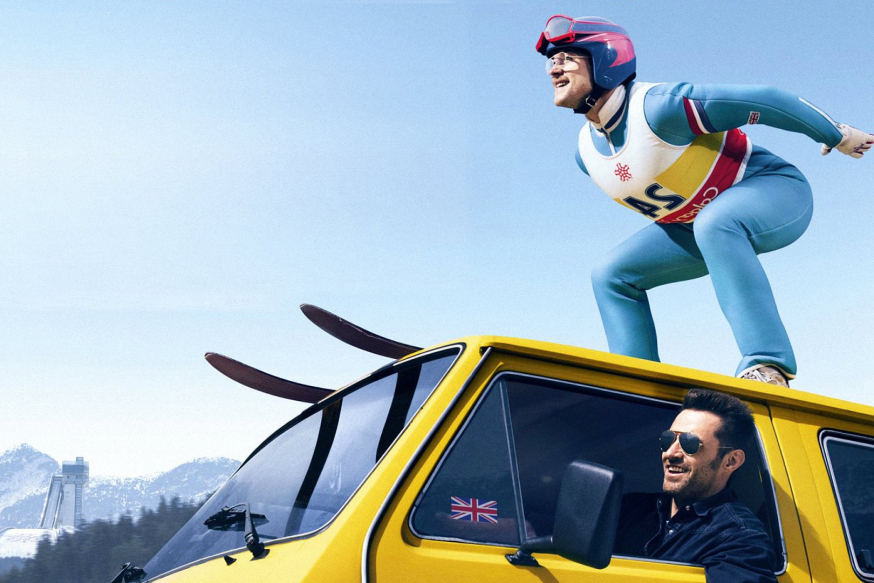
Hvis du kan huske Eddie the Eagle fra en Vinter Olympiade for alt for mange år siden så er filmen ude som DVD. Nedenfor finder du Q&A med instruktøren.
Before he was a director, Matthew Vaughn was one of Britain’s most successful producers, having worked with collaborator Guy Ritchie on the critically acclaimed films LOCK, STOCK AND TWO SMOKING BARRELS and SNATCH.
It was with 2004’s LAYER CAKE, based on a screenplay by JJ Connolly and adapted from his novel, that Vaughn made the transition to helmer. Hinting at a talent for casting that would endure through his subsequent films, Vaughn cast a pre-Bond Daniel Craig and a pre-INCEPTION Tom Hardy. Critics hailed Vaughn as a director to watch, with Washington Post critic Stephen Hunter noting, “Vaughn has a flair not merely for action and ambiance but also for character.”
This mix has served Vaughn well throughout his career, but few could have guessed that his next step would have been into the realms of fantasy. 2007’s STARDUST, based on the novel by Neil Gaiman, told the story of a young man (Charlie Cox) who promises the woman he loves that he would seek out a fallen star (Claire Danes) and bring it back to her. It was the first film for which Vaughn co-wrote the screenplay with his now-regular collaborator Jane Goldman, and the pair have gone on to co-write all of Vaughn’s subsequent directorial projects.
Vaughn began a creative partnership with the comic book writer Mark Millar when, in 2010, he and Goldman adapted Millar’s comic book KICK-ASS for the big screen. The film, which starred Aaron Johnson and Chloe Moretz, was acclaimed for its wry twist on the superhero genre, telling the story of a young boy who wonders why more people don’t dress up in costumes to fight crime.
Vaughn revived the X-MEN franchise the following year with X-MEN: FIRST CLASS. James McAvoy and Michael Fassbender played the young Charles Xavier and Erik Lensherr respectively, roles originated in Bryan Singer’s X-MEN series by Patrick Stewart and Ian McKellen.
Vaughn and Goldman returned to the X-MEN universe in 2014, collaborating with writer Simon Kinberg on the story for X-MEN: DAYS OF FUTURE PAST. And last year, Vaughn directed KINGSMAN: THE SECRET SERVICE, a further collaboration with Goldman and comic book author Mark Millar.
Returning to producing, Vaughn’s latest project is a big-screen adaptation of EDDIE THE EAGLE, the story of a young man’s impossible dream to compete in the Olympics. Directed by Dexter Fletcher and starring Taron Egerton and Hugh Jackman, the film is an inspiring, hopeful tale about triumph over adversity… even if “triumph” doesn’t necessarily mean taking gold.
How long has this project been in the oven?
The way EDDIE THE EAGLE started is I read the script about 15 years ago and I thought it was charming. I couldn’t believe what this young guy went through. We were asked whether Guy Ritchie and I wanted to direct and produce it. Guy didn’t want to direct it and I was just a producer back then. I thought it was worth making but it didn’t happen.
Cut to 15 years later and I was watching COOL RUNNINGS with the kids. They loved it and they were like, “Why do people not make movies like this anymore? This is so funny, and it makes me feel good.” I sat there going, “Hmm… It’s a good point.” The light bulb went off in my head and EDDIE THE EAGLE, the script, came back to my mind. I tracked it down and it was just sitting with nobody wanting to make it. I bought the rights and rang up Dexter Fletcher because I loved WILD BILL, and thought he did a great job on it. It had the heart that I needed.
How did he react?
He thought I was joking. I said he should read the script, so he read it and said, “Oh. I think there could be something in this.”
We sat down and I said I’d do a bit of a rewrite and we’d dial up the emotion and dial down the comedy. The whole point about EDDIE THE EAGLE is it’s a dramatic story. THE FULL MONTY, BILLY ELLIOT, they’re dramedies in my mind. Inspirational, dramatic films with feel-good and fun, but the comedy is a supporting role. We decided to make it more RUDY, ROCKY, BREAKING AWAY.
And then I rang Taron Egerton up, and I thought I’d give Hugh Jackman a call. I’m lucky to know these people so I thought I could get them to read it, and Hugh said, “Oh, I used to pretend to be Eddie the Eagle, diving off the roof into the pool in Australia.”
Hugh said Eddie was a real, Australian kind of hero.
Oh, totally. The only difference is he doesn’t win. If he were Australian he’d have broken every world record. [laughs] Eddie’s an inspiring guy, and what I’m most excited about with this movie is that people will see it and will no longer think of Eddie the Eagle the clown, they’ll think of Eddie the Eagle the hero.
Do you think it’s hard to imagine a world in which an Eddie could exist today?
Yeah, it’s too corporate now, and too regulated. There are too many Health & Safety hurdles. We weren’t even allowed to jump with the old equipment. We were banned. That was a worry – could the skis look different? The stuntmen and the ski jumping guys were like, “This is insane.” They couldn’t believe that he didn’t die. He literally risked his life with every jump. Those days are over.
Dexter had never directed action before. How do you think he handled the process of telegraphing that sense of danger that Eddie faces?
He’s done it brilliantly. You watch this film and you’re thinking, “My God, is he going to survive?” It’s dangerous and you’re seeing people get really badly hurt. The scale of these jumps… I went up to the top of the 90 metre jump, and I’ve never had vertigo before, but I clung on. We were doing a scene up there and I was like, “Screw this, I’m going back down.” There was no way I could have fallen off, it was totally safe, but it’s weird that you’re 90 metres up and if you slipped you’d go sliding down to your death. Whoever invented ski jumping was insane. It’s one of those things that there’s no logical reason for doing.
It even gave Hugh nightmares.
Yeah – before the movie he was like, “I’m going to do it for real with a safety harness on.” He got to the top and he was like, “Screw that! Let’s figure out a safer way of doing it.” Those guys are brave. The first time Eddie jumps in the movie, you’re amazed because Eddie just did it. No one starts ski jumping at his age. Hugh’s character says to him, “Either you’re incredibly stupid or incredibly brave; or both.” And I think he was.
You’d worked with Taron on KINGSMAN: THE SECRET SERVICE, in which he became a suave spy. What made you think of him for Eddie, who was far from suave?
I knew he had enormous talent and I knew he could pull it off. At the end of the movie, a photo of the real Eddie pops up and the test audience were like, “Why are we seeing a still photograph of Taron?” You cannot tell the difference.
I’m a big believer that great actors can pull it off. Daniel Day-Lewis doesn’t look like half the people he plays and yet you never doubt it. Great actors can truly play any role. Same with Eddie Redmayne when he played Steven Hawking; he became that character. I didn’t have a single doubt that Taron could pull it off.
The movie hinges on the chemistry he shares with Hugh Jackman’s character, Bronson Peary. How essential was it to get that right?
As a director, if you look at the pedigree of actors I’ve worked with, there’s a reason for it and it’s because they make me look a lot better. It’s a lot easier directing someone that you’re just tweaking sometimes and Hugh and Taron are as good as they get.
You round out the cast with some incredible faces like Christopher Walken and Jim Broadbent. How did that group assemble?
Again, it comes down to the subject matter. Most scripts you read nowadays are incredibly formulaic and cynical and commercial. With EDDIE THE EAGLE, it was just such a great story, and all of the actors read it and melted. It’s fun to be part of something that you just know you’re going to be proud of. For everyone who read it, it reminded them of how they got into the film business and how hard things were as they were starting out as actors. People were generally jumping aboard and it wasn’t hard to get anyone.
The film is all heart.
People come out streaming in tears. We showed it to the real Eddie the Eagle and that was weird for him, but again he was crying his eyes out. He was so sweet, and he said, “Now people will take me seriously and understand what I went through.” Dexter, myself, Hugh and Taron, we all wanted to make a feel-good film. Where have they all gone? Where are those films where you can watch it and feel inspired?
On a selfish level, I also wanted to do a movie I could show my kids. I can never show them any of my movies. [laughs] By the time they’re old enough to legally watch them, they’re going to be so passé and old, so I thought it’d be great to make a film where I could bring them into the editing room and see what they think. It’s been a really lovely process and a really enjoyable movie to make and it’s turned out better than I could ever have hoped, so I’m very, very happy.
Why do you think optimism is so important in the cinema?
Cinema is very influential on popular culture and maybe it’s because I’ve got kids, but you want them to be happy. I said this about KINGSMAN, when people asked, “Why do you bang on about manners?” I think the world would be a lot safer and a lot happier if every single person on this planet lived by the same high, moral and ethical code and had impeccable manners. Maybe this movie will take someone who was being a bit angry and nasty and soften them. Eddie overcame being a kid with callipers on, who nobody wanted on their team. He was bullied and no one took him seriously, yet he succeeded. Everyone should have that confidence inside, and be given the chance to be confident and not be put-down and pigeonholed before they’ve even started.