













Bethesda har allerede nu 2 afsnit ude af deres “22 grunde til at elske Doom”. Det er en lidt længere artikkel så du får den direkte på engelsk. God fornøjelse med del 1 og del 2.
Twenty-two. While that might not seem like a huge number – you’re barely an adult when you’re 22 – it’s massive when it comes to the history of videogames, spanning multiple hardware generations and numerous industry innovations. That’s why we’re celebrating the 22nd anniversary of DOOM’s release (originally out on Dec. 10, 1993) not by looking back at the original game, but by looking ahead to the new DOOM, releasing this spring.
“DOOM is Deathmatch, an attitude, an expression,” says Senior Producer Sean Bean. “It’s rock-n-roll and sending demons straight back to Hell with a double-barrel shotgun with blood on your face. DOOM is id.”
Whew. While that’s a huge legacy to uphold, the team at id Software is on track to deliver a game that does the original proud while creating something altogether new. So let’s push forward with an inside look at the weapons, the characters, the demons and the teams behind DOOM.
Your Fists
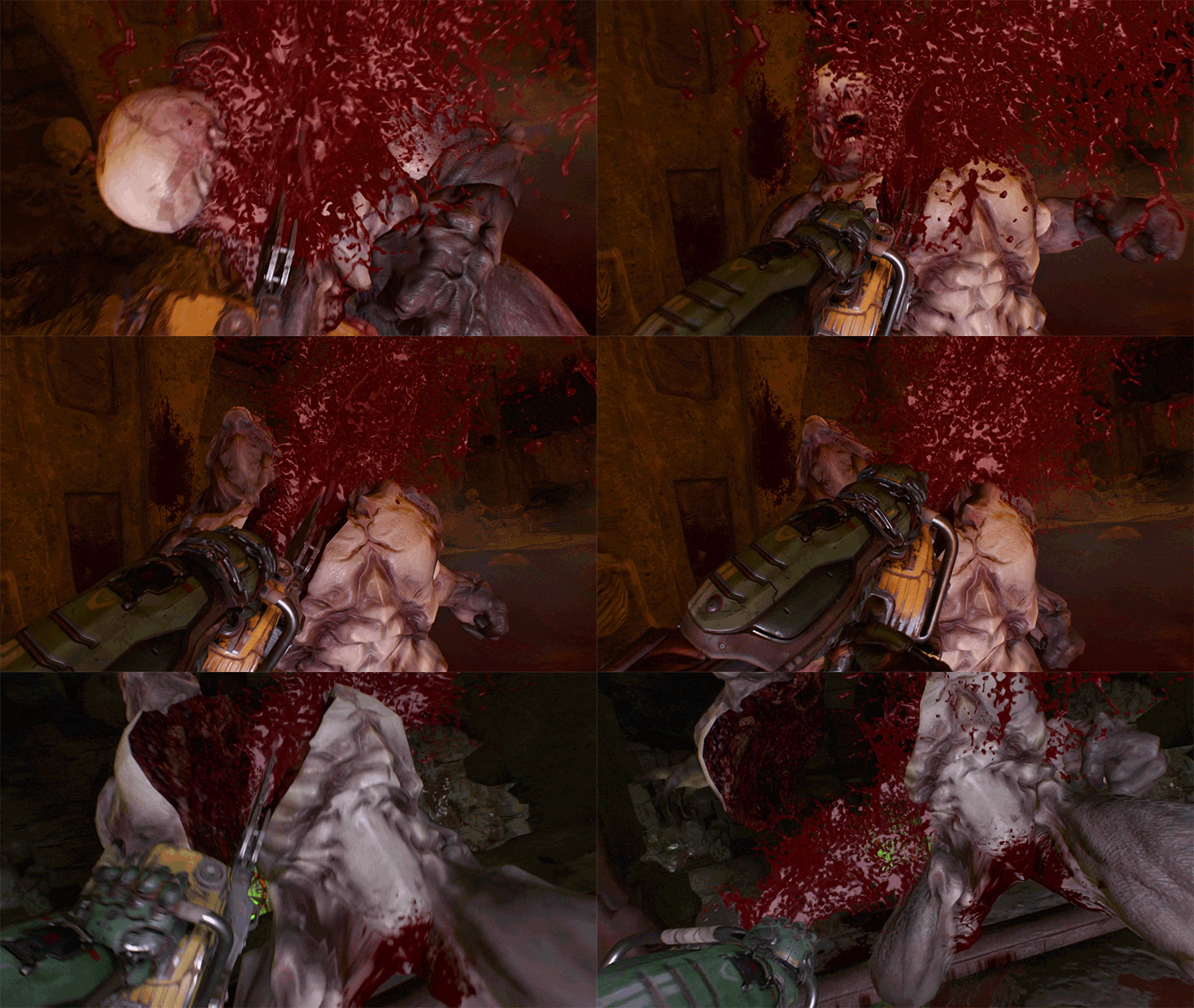
DOOM has always been about visceral, up-close combat. Nothing is more intimate than a swift smack right to the meaty maw of a charging demon. In the new game, though, these melee attacks have taken on an expanded role. With Glory Kills, DOOM now includes brutal finishing moves that look great, feel great (trust us, they’re tons of fun to execute) and, most important, have strategic value: Demons dispatched with a Glory Kill drop more health and supplies. “It’s like this hit of adrenaline every time you do it,” says Executive Producer Marty Stratton. What’s more, Glory Kills are context sensitive (the animations change depending on where you’re looking) and never disrupt the push-forward flow of the combat. “We have very strict time limits on how long they can last,” says Chief Technology Officer Robert Duffy. “They’re hundreds of milliseconds, just because you want to keep the player moving.”
Domination Through Animation
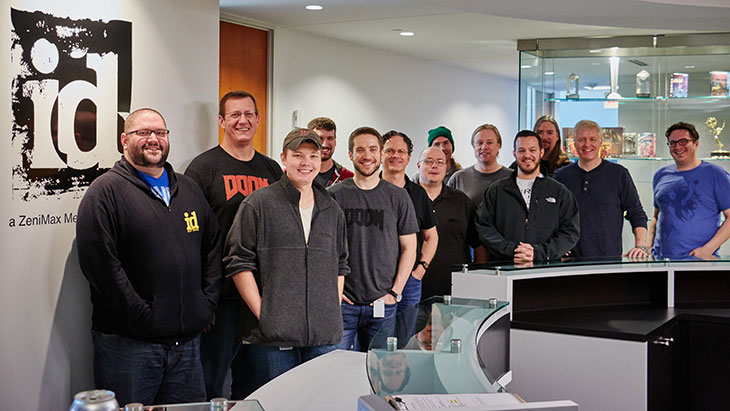
Speaking of Glory Kills, there’s a ton of animation that goes into each and every one of them. And into the rest of DOOM, as well. It’s all produced by one of the hardest-working animation teams in the business. “We have a diverse group of animators that can handle all situations, from mo-cap to creating gore rigs and models, and then animating and implementing them in the game,” says Senior Animator Brett Paton. “As a team we are trying to push seamless and visceral melee combat without slowing down the overall shooting and movement mechanics that id is well known for.” And the team isn’t just looking at DOOM’s rich legacy for inspiration. According to Paton, they’re also building on the acrobatic enemy movements and traversals from RAGE, another recent id Software game that was widely acclaimed for the enemy AI and animations.
BFG
The name says it all. It’s big, it’s a gun… and it’s a highly effective way to $#%& up demons. “The BFG was – and still is – the most powerful gun in the universe,” says General Manager Garrett Young. ’Nuff said.
Hell
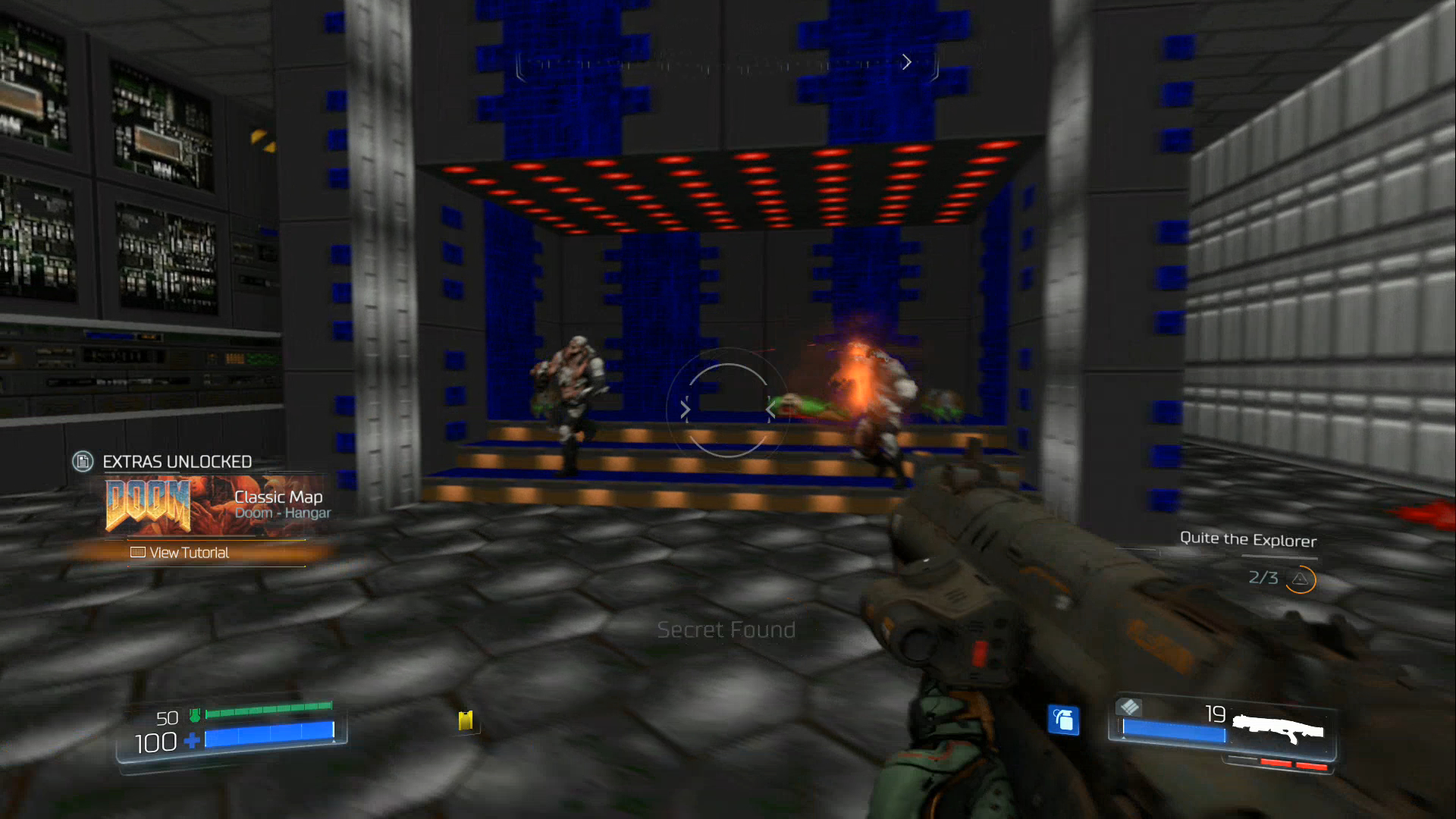
You’ll need all the power you can get, especially when you descend into the depths of Hell. But while your blood-soaked sojourn to the fiery realm might feel familiar to longtime fans of the series – the art team worked hard to capture the essence of the stylized representation of Hell first seen 22 years ago – they’ve also enhanced this vision with a more modern and realistic approach. “Hell is a big part of what makes DOOM intriguing to players,” says Environment Lead Lear Darocy. “The art team had a lot of fun bringing this environment into the current gen, and is pushing the new tech to better help immerse the players in the DOOM universe.”

DOOM Marine
Speaking of Hell, there’s no better person to take on the fiery realm than the DOOM Marine. Why? “Hell fears you, not because you’re invulnerable,” says Senior Producer Sean Bean, “but because you’re faster, stronger, smarter, and pissed.”
The Art of War
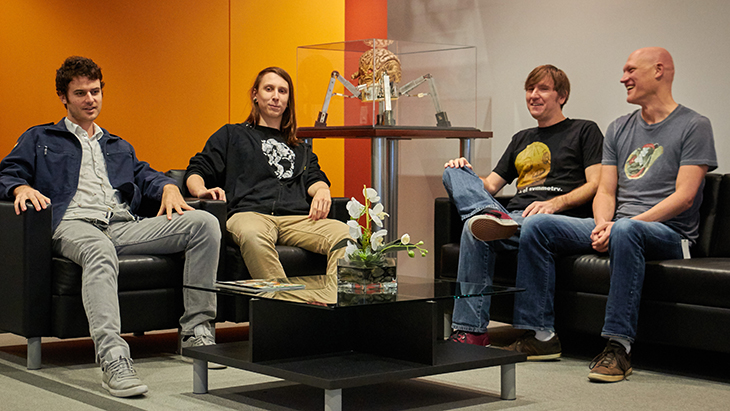
Unlike the DOOM Marine – a solitary figure that must face hordes of demons on his own – a game isn’t the work of one person alone. Led by Art Director Hugo Martin – who joined id a few years ago after a career that spanned both games and Hollywood (including art for the movie Pacific Rim) – the id art team has evolved into a group that prizes teamwork above all else. And they are constantly pushing themselves to be better.
This is essential because, according to Darocy, their goal is to once again raise the bar, much in the same way the original game did. “It adds a great deal of pressure because we aim to repeat history and reintroduce DOOM into pop culture again as well as revitalize the franchise,” he says. “It’s a tall order that requires true teamwork. We push ourselves technically, and we are always learning new processes to improve art.”
Pop Culture Icon
Of course, DOOM is already a pop culture icon. Not only was there a movie starring Dwayne Johnson (back when he was still going by “The Rock”). Not only has the original game been ported to just about every single device that can hold a current – from consoles to handhelds to printers and ATMs. But there have been a host of other pop culture callouts over the years – including guest appearances on some of our favorite TV sitcoms. “DOOM was on Friends,” Paton laughs. “I mean Chandler played it in an episode!”
Popularizing the FPS
It’s easy to see why DOOM has been so pervasive in pop culture. While DOOM wasn’t the first FPS – id Software’s Wolfenstein is generally credited for launching the genre – it was the game that made first-person shooters so popular. In fact, it took a while for the term “FPS” to catch on; new games in this budding genre were initially referred to as “DOOM clones” by the critics and community. But what was it about DOOM that made it such a breakthrough hit? For Audio Director Chris Hite, it’s all about the attitude. “While the culture and environment looks very different than what it was 22 years ago, there will always be a place for irreverence,” he says. “Just referencing technology and graphics is a trap, and it ignores the more fundamental aspects of what makes DOOM so great. DOOM, and id Software as a whole, has always represented for me a bit of defiance. When everyone goes right, we tend to go left. There is an honesty with DOOM, a purity to it that is just as accessible today as it was 22 years ago. Gamers can immediately feel it. I think that this, above all else, is what keeps DOOM in the hearts and minds of the older generation and the new.”
“There was nothing, nothing like it at the time,” adds Senior Producer Sean Bean. “It was ridiculous and fast and cathartic and unapologetic… and frickin’ hard. It’s relevant now because it’s primal, the part of us that never goes away.”
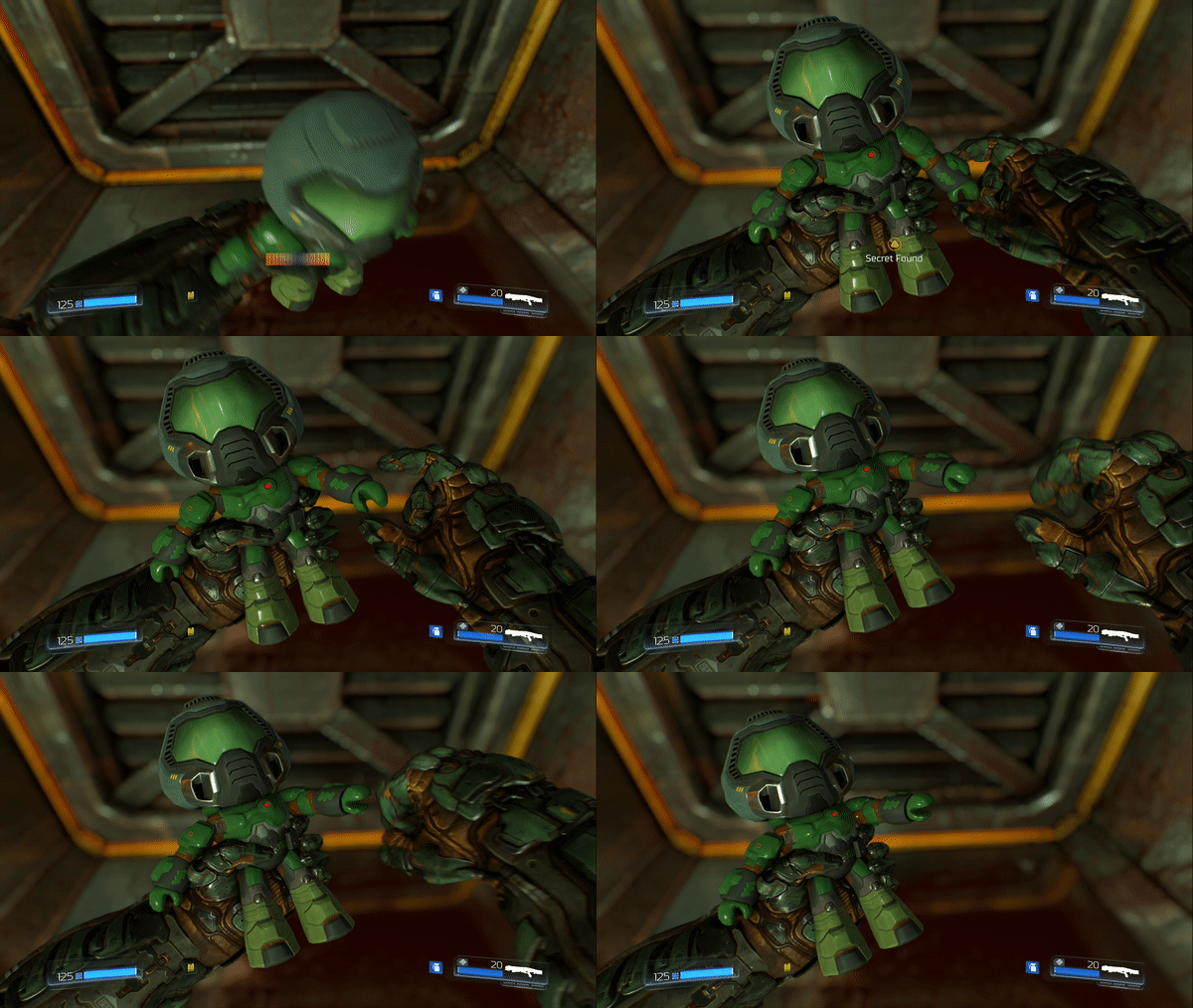
Capturing this attitude and experience – and bringing it to the current generation of gamers – has been a big focus for Executive Producer Marty Stratton. “Our approach has been that this game needs to first and foremost be incredibly fun,” he says, “no matter your past history with DOOM. If someone has never heard of DOOM before, I think we will make them a fan. But, for those who are already fans, I hope they see and appreciate the inspiration we’ve drawn from the legacy of DOOM and enjoy how that permeates everything, from the combat, guns and characters to some of our best secrets.”
Shotgun / Super Shotgun
Some of DOOM’s popularity can be attributed to its iconic weaponry, including one of the most iconic of them all: the Shotgun (as well as the Super Shotgun). Originally modeled after a toy (the original still sits in a trophy case in the id Software offices), this powerhouse packed a major punch back in the day, and it still does the dirty work in the new game. “I love the Super Shotgun,” says General Manager Garrett Young. “It wrecks!” Executive Producer Marty Stratton agrees, adding: “The combination of the player’s fast movement speed and the close-range punch of the Super Shotgun make it really fun.” It’s also a favorite for Senior Animator Brett Paton. “I think it looks the best of any shotgun in any game to date – and there have been some good ones out there,” he says. “It looks great and packs a punch. Plus it has a few tricks up its sleeve…”
Deep Bench of Demons
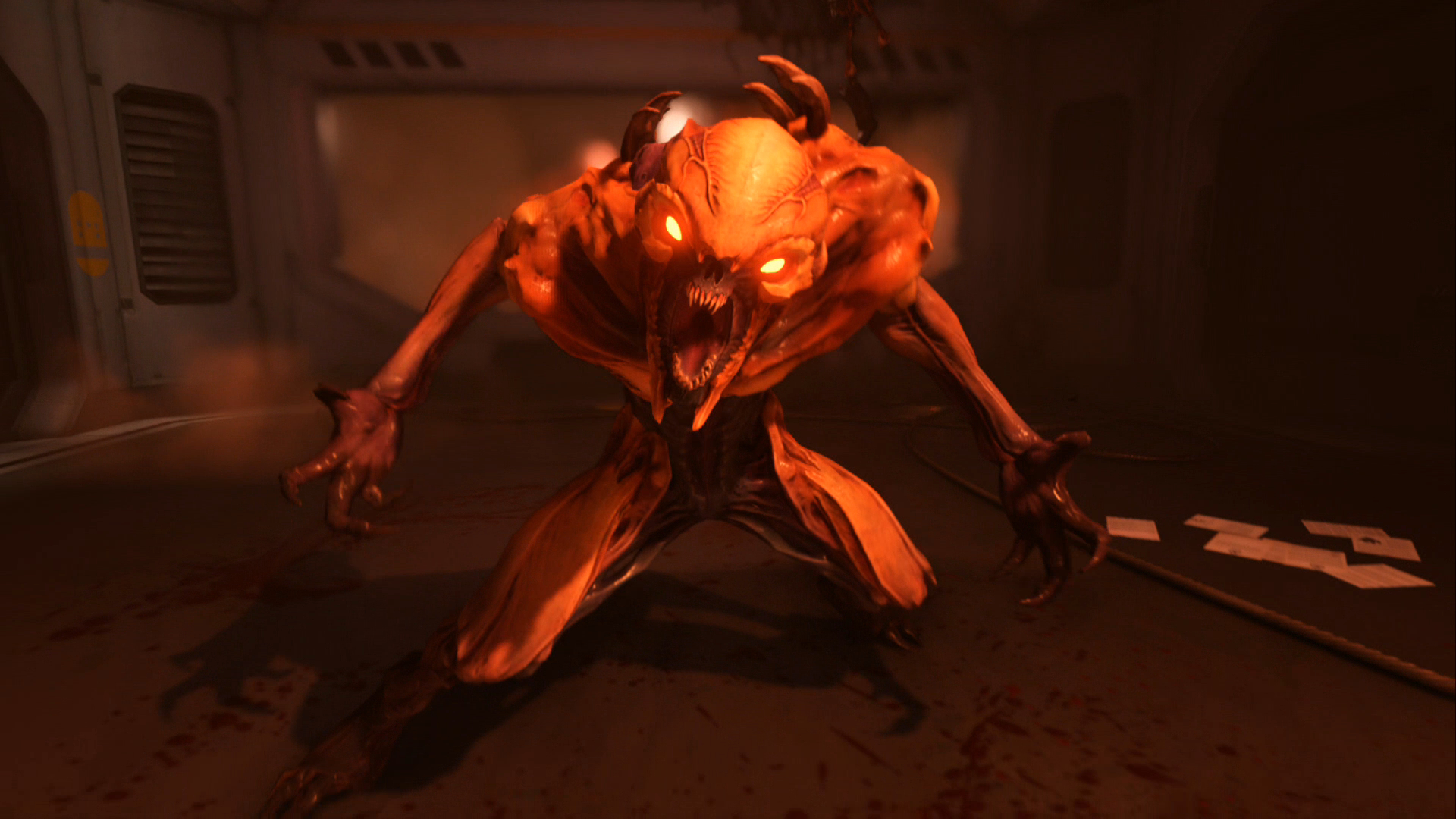
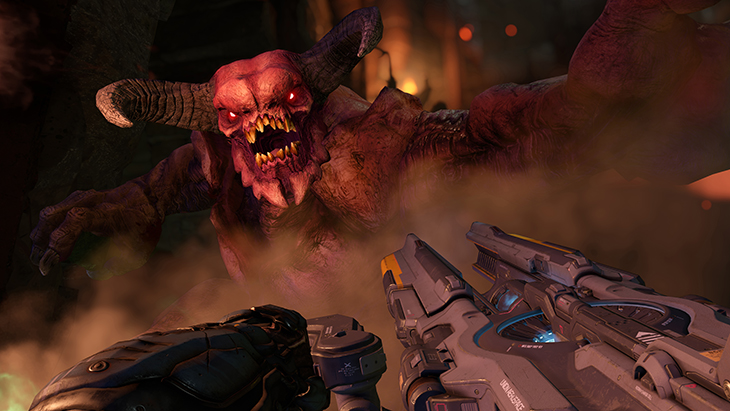
Powerful weapons wouldn’t matter without some ferocious foes standing in your way. DOOM brings back its unruly roster of Demons, including the Revenant, Mancubus, Pinky, Imp and Cacodemon. The team at id looked back to the original games for inspiration, but reinvented these iconic enemies to create something that fits the vision of the new game. And everyone at id has a different favorite. “I really like our new Mancubus,” Stratton says. “He looks great and he’s fun to fight against.” Environment Lead Lear Darocy enjoys how another big baddie has evolved. “The Hell Knight was a very intimidating demon in DOOM 3,” Darocy says. “We brought back everything that made this demon what it is, and pushed that even farther in the new DOOM.” For Young, though, it’s a smaller foe that gives him fits. “Our big guys scare the hell out of me, but the Imps may be my favorite,” Young says. “They stick and move, they shoot you from walls, and on higher difficulties their fireballs will destroy you. Be warned.”
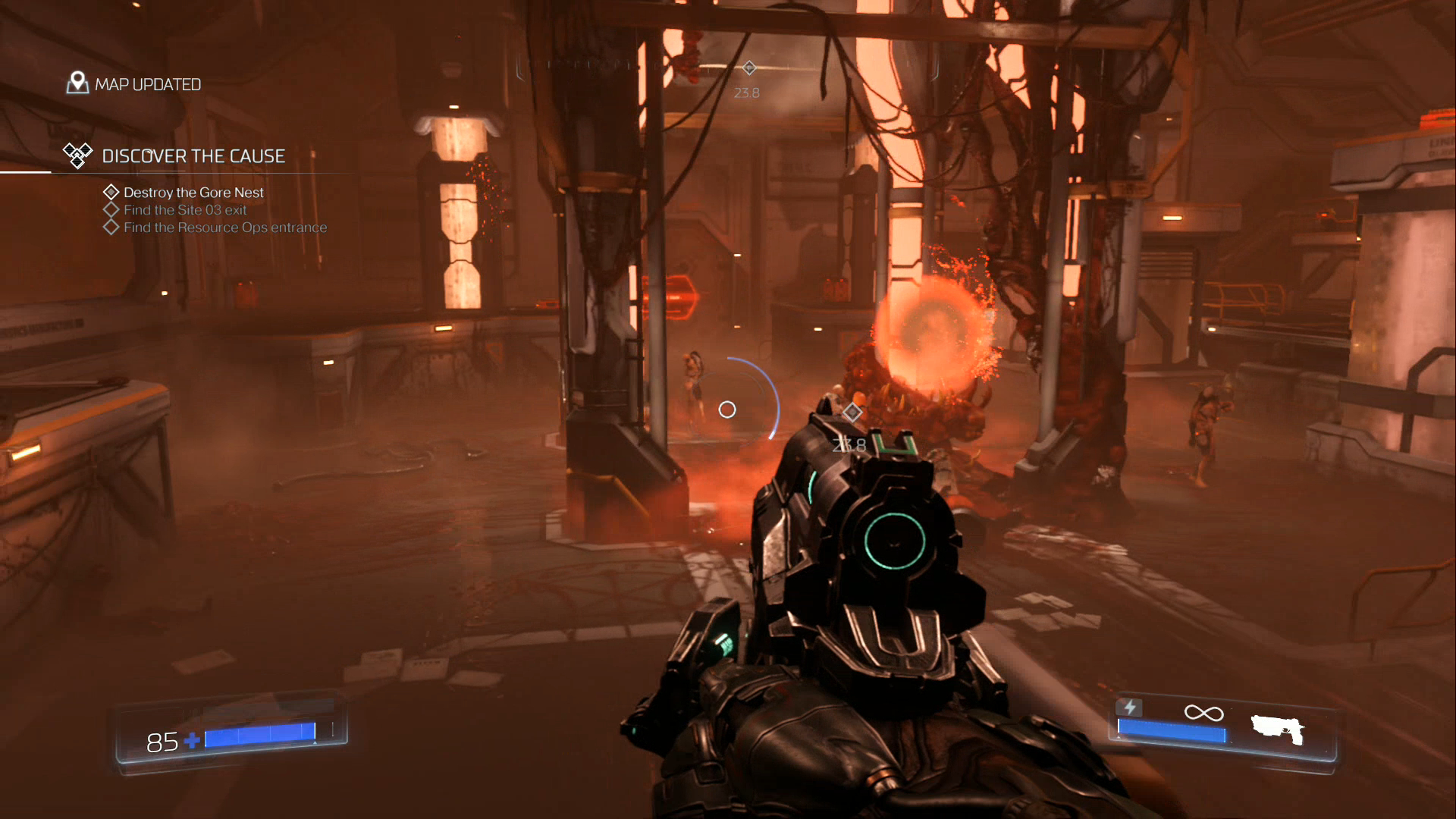
Chainsaw
Yes, it’s back. Yes, it’s as brutal as ever. But this time around it also has a strategic role in the game. Though it has very limited fuel, it’s a one-hit-kill option that will not only brutally eviscerate a demon but also deliver copious ammo – often when it’s needed most.
An Arsenal of Options
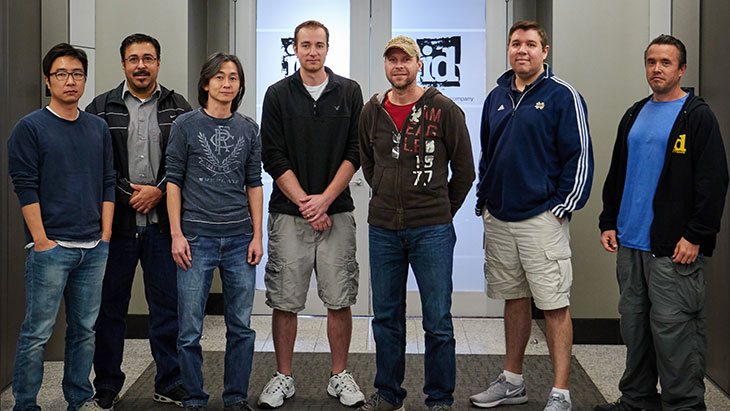
For Designer Peter Sokal, DOOM’s core gameplay can be distilled down to a singular notion. “With your speed and weapons, DOOM gives you the tools to be the ‘alpha’ in any encounter,” he says. But, much like the art team (see Part 1), the id design team enjoys a spirit of collaboration that stands in contrast to the lone DOOM Marine. Sokal is especially proud of how the team continually iterates on each other’s work to improve the gameplay experience. “We are constantly getting feedback from one another on our work. This has helped us grow as a team, collaborate more, and ultimately get a better end result in the game.”
It’s all about exploring the best options – a notion that’s reflected in the game itself. “While there are many new things for players to enjoy, a big one is having more options in how they approach combat,” Sokal says. “We have customization elements that can allow for some very different gameplay experiences. I’m very excited to see what types of combinations people come up with.”
Push-Forward Combat
At the core of the gameplay is the notion of push-forward combat – an evolution of what defined the combat in the original DOOM. “Our animation director and his team were the first to really coin this term,” Stratton says. “It was born out of the idea that many FPS games put players on their heels – hiding behind cover, moving backward. DOOM is all about moving forward, being faster than the enemy, and taking the fight to them. So with the combination of using weapons to stagger enemies, the fast closing speed of the character and the violent close-range finishing moves (Glory Kills), we’ve created something that is highly addictive but fits completely with the tone, speed and style of DOOM.”
“The push-forward style of our combat rewards players for being aggressive and not backing down from a challenge,” Sokal adds. “If you are low on health, charge into the maw and blow a demon in half to get a nice chunk of your health back. Low on ammo? Pull out the Chainsaw and cut a demon apart to get a huge ammo refill. For me, these moments are some of the most satisfying in the game.”
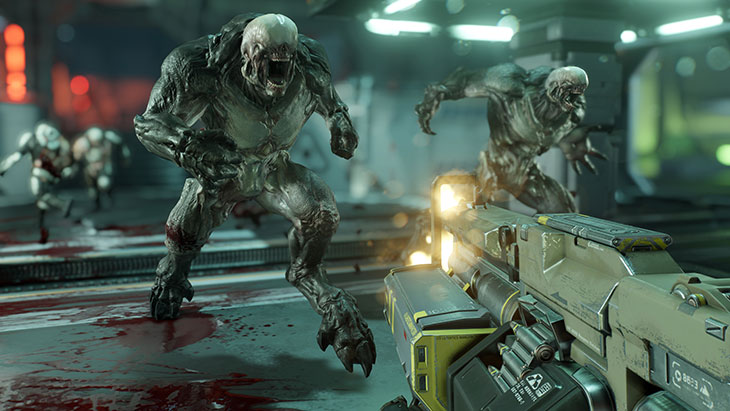
As Young points out, shooting is far from the only thing that matters in DOOM. “What most people don’t understand is that the original DOOM wasn’t so much about shooting,” he says, “it was about movement. Targeting was easy: there was no reticle. The challenge was to stay alive – and that required movement. Today’s DOOM takes this lesson as gospel. Yes we have a reticle, but if you stay in one place too long, you’re done for. DOOM is not a tactical shooter. You want to win? You better move.”
New Single-Player Weapons
Movement might be key to staying alive, but your DOOM Marine still needs all the heavy ordnance he can get his hands on. Along with all the returning (and fully updated) classic weapons, DOOM has two new guns in single-player: the Gauss Cannon and the HAR (heavy assault rifle).
Serious Sounds
It’s not enough to blow away demons. Players want to feel the raw power of being a DOOM Marine deep in their gut. Nothing helps enhance the sensation of utter dominance like great sound design. In fact, that’s the guiding principle for DOOM’s audio team: “To define and deliver an audio experience that is based on the DOOM Marine power fantasy,” says Hite. Tall order indeed, but the team is up to the task. “Our game sounds unique in many ways, and I’m proud of how it stands out,” Hite says. “We have a good mix of the old and new.”
As for what specifically helps bring this power fantasy to life, Hite points to two aspects in particular. First, the weapons: “We are excited for the world to experience what guns sound like in a 2016 DOOM game,” he says. Second, the score: “The musical treatment is the perfect mix of the early standout and often-referenced Bobby Prince tracks,” Hite notes. “It’s also a look forward to what a modern sci-fi shooter should sound like.”